Subcontractor Insurance Requirements: What to Ask For
Karla · · 11 min read
Every subcontractor you bring onto a job carries some of your risk with them. If a framing sub’s worker is hurt or a plumbing sub floods a finished unit, the question becomes whose insurance pays, and the answer depends on what you asked for before they started. This guide covers subcontractor insurance requirements in practical terms: the coverage subs usually carry, how to decide what to require, which endorsements matter, and how to get proof in hand before anyone mobilizes.
This article is general information, not legal or insurance advice. Check your contracts and talk to your insurance broker or attorney about your situation.
Why subcontractor insurance requirements matter
When you hire a sub, you are usually promising someone else (the owner, a developer, a lender) that the work will be insured to a certain standard. Your prime contract almost always spells that out. If your subs don’t carry matching coverage, the gap lands on you: your own policy may end up responding to a loss the sub caused, which can affect your premiums and your claims history.
Clear requirements also make life easier on the sub’s side. A sub who knows from the bid stage exactly what you need can call their agent once and get it right, instead of sending three certificates over two weeks.
If you are building a broader tracking process for every vendor, not only subs, start with our guide to certificate of insurance tracking. This post focuses on the construction side.
The coverage subcontractors usually carry
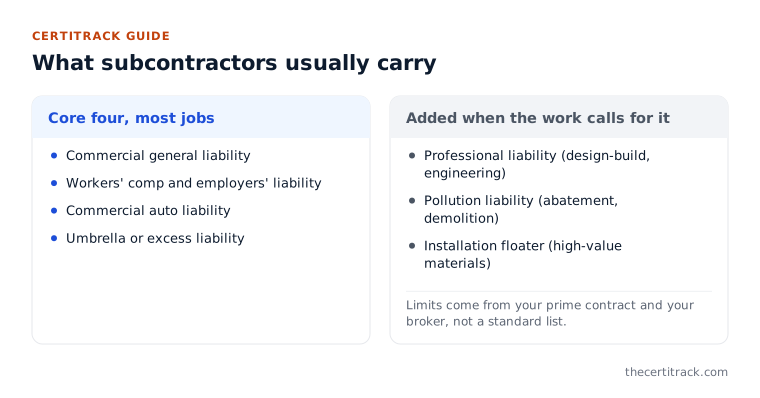
Most trade contractors carry some combination of the policies below. Not every sub needs every line, and the right mix depends on the work.
| Coverage | What it generally covers | Usually required for |
|---|---|---|
| Commercial general liability (CGL) | Bodily injury and property damage to third parties caused by the sub’s work or operations | Almost every sub on site |
| Workers’ compensation and employers’ liability | Injuries to the sub’s own employees; employers’ liability covers related lawsuits | Any sub with employees (rules vary by state) |
| Commercial auto liability | Injury or damage caused by vehicles used in the business | Subs who drive company vehicles to or on the site, or haul materials |
| Umbrella or excess liability | Extra limits on top of the CGL, auto, and employers’ liability policies | Larger jobs, higher-risk trades, or when the owner requires it |
| Professional liability (E&O) | Errors in design or professional advice | Design-build subs, engineers, anyone stamping drawings |
| Pollution liability | Releases of hazardous materials | Abatement, demolition, environmental, some mechanical work |
| Installation floater or inland marine | The sub’s tools, equipment, or materials in transit or before they become part of the building | Subs installing high-value equipment or materials |
The core four for most jobs are general liability, workers’ comp, auto, and umbrella. The specialty lines come in when the work itself calls for them.
Commercial general liability
This is the policy you care about most. On a certificate, it usually shows several limits: each occurrence, damage to rented premises, medical expense, personal and advertising injury, general aggregate, and products-completed operations aggregate. Your contract typically sets requirements as a per-occurrence amount and an aggregate amount.
Pay attention to two details. First, whether the general aggregate applies per policy, per project, or per location. A per-project aggregate means one sub’s busy year on other jobs can’t use up the limit available for yours. Second, the products-completed operations coverage, which matters because construction claims often show up after the work is finished.
Workers’ compensation
Workers’ comp rules are set by each state, and they differ in ways that matter for you. Who must carry it, whether sole proprietors or LLC members can opt out, how exemptions are documented, and how proof is issued all vary. A few states run workers’ comp through a state fund instead of private insurers, so the proof may look different from a standard certificate.
Why you care: in many states, if your sub has no workers’ comp and their employee is injured on your job, the claim can come back to you as the hiring contractor. Ask your broker how this works in the states where you build, and check your state’s workers’ compensation agency for its exemption rules.
Auto and umbrella
Auto liability matters for any sub whose trucks come on site. Umbrella or excess coverage sits on top of the other liability policies and raises the total amount available. Owners on larger projects often require it, and it is usually how a sub meets a high total limit without buying an enormous primary policy.
How to set your requirements
There is no single correct set of limits for every sub. The right numbers depend on the contract, the job, the trade, and your broker’s advice. Here is how most GCs arrive at them.
Start with your prime contract (flow-down)
Your contract with the owner usually lists the insurance you must carry and often says your subs must carry the same or similar coverage. This is called a flow-down. Read the insurance section of the prime contract first, then make sure your subcontract requirements meet or exceed it. If the owner requires being named as additional insured on your policy, they will often require it on your subs’ policies too.
Adjust by trade and risk
A painter working on an occupied office floor and a crane operator on a high-rise do not carry the same risk. Many GCs use two or three tiers:
- Lower risk: finish trades, low-rise interior work, small scopes. Standard GL, workers’ comp, and auto.
- Moderate risk: mechanical, electrical, plumbing, roofing on small buildings. Higher limits, often an umbrella.
- Higher risk: structural steel, demolition, crane work, excavation near utilities, roofing at height, abatement. Higher limits, umbrella, and specialty lines like pollution where relevant.
Say your prime contract requires a certain GL limit and an umbrella. You might pass those exact amounts to your higher-risk subs and allow lower amounts for a drywall sub, as long as the owner’s contract permits it. Your broker can tell you where you have room and where you don’t.
Write it into the subcontract
Put the requirements in the subcontract or an insurance exhibit attached to it, not only in an email. Spell out each coverage line and the limits, the endorsements required, who must be named as additional insured (with exact legal names), how long completed operations coverage must be maintained after the job, and what happens if coverage lapses (for example, that you may withhold payment or stop work).
Endorsements commonly required
The certificate is a summary. The rights you actually rely on usually come from endorsements added to the sub’s policy. These three show up in most construction subcontracts.
Additional insured
An additional insured endorsement extends the sub’s liability coverage to you (and often the owner) for claims arising from the sub’s work. In construction, look for coverage of both ongoing operations and completed operations. These are frequently written on standard ISO forms, such as CG 20 10 for ongoing operations and CG 20 37 for completed operations, though insurers also use their own forms and the edition dates vary.
On the ACORD 25, there is an ADDL INSD column next to each policy. A “Y” there tells you the agent believes an additional insured endorsement applies. It does not, by itself, give you any rights. The form says plainly that the certificate does not amend or extend the coverage. For the full difference between being listed and being covered, see our post on how to read an ACORD 25.
Waiver of subrogation
When an insurer pays a claim, it can usually try to recover the money from whoever caused the loss. A waiver of subrogation endorsement gives up that right against you. Without it, the sub’s insurer could pay a claim and then come after your company. Contracts often require it on GL, auto, workers’ comp, and umbrella. The SUBR WVD column on the certificate signals it, but again, the endorsement is what counts.
Primary and non-contributory
This wording (primary and non-contributory) means the sub’s policy pays first, before yours, and won’t ask your policy to share the loss. It protects your own limits and loss history. Look for it in the endorsement language, not just in the certificate’s description box.
Checking endorsements takes a human
None of these endorsements can be confirmed from the certificate alone. To check them, request a copy of the actual endorsement pages, read who is covered and for what, and ask your broker to review anything unusual. Watch for endorsements limited to “ongoing operations” when your contract requires completed operations, or blanket endorsements that only apply “where required by written contract” (which is fine only if your written contract actually requires it).
CertiTrack’s AI reads the dates, policy numbers, insurers, and coverage amounts from a certificate so you don’t retype them. It does not verify endorsements or policy wording. That review stays with you and your broker.
What to collect from each subcontractor
Before a sub starts work, most GCs want these documents on file:
- Certificate of insurance (usually an ACORD 25) listing all required coverage, with your company correctly named as certificate holder.
- Additional insured endorsement pages for GL (and auto or umbrella, if your contract requires them).
- Waiver of subrogation and primary and non-contributory endorsements, if required.
- Workers’ comp proof or a state exemption document, if the sub claims an exemption.
- Contractor license (how to verify one) for the trades and states that require one.
- W-9 for payment and tax reporting.
- Signed subcontract with the insurance exhibit.
For a broader list that covers non-construction vendors too, see the vendor compliance checklist.
Collect everything before mobilization
The easiest time to get a certificate is before the sub needs something from you. Once they are on site, you have less to bargain with and more pressure to let it slide.
A simple rule that works: no certificate, no badge, no start date. Make it part of your onboarding, and tell subs about it at bid time so nobody is surprised. In practice:
- Send your insurance requirements with the bid package or the subcontract, not after award.
- Ask for the certificate and endorsements as soon as the subcontract is signed.
- Review them against the contract before the pre-construction meeting.
- Confirm the policy dates cover the whole schedule, or note when renewals fall mid-job.
With CertiTrack, you can send each sub a secure link to upload their certificate from a phone or laptop, with no account to create. The AI pulls the dates and limits, you confirm them, and each sub gets a compliance score you can check before the start date.
Keep it current during the job
Policies renew, usually once a year, and a job that runs 18 months will cross at least one renewal for most of your subs. The certificate you collected at mobilization will expire before the job ends.
Set reminders well ahead of each expiration date. CertiTrack emails the sub automatically at 90, 60, 30, and 7 days before a document expires, with a secure link to upload the renewal, and sends your team a copy. The renewal request goes out long before the old certificate lapses. It also warns you when you mark a payment as paid to a sub who isn’t compliant, which is often the moment a sub is most motivated to send updated paperwork.
For construction-specific workflows, see how CertiTrack is used in construction.
A quick checklist for your next subcontract
- Read the insurance section of your prime contract and note every flow-down requirement.
- Decide which risk tier this sub falls into and set limits with your broker.
- Put coverage, limits, endorsements, and additional insured names in the subcontract.
- Collect the certificate and endorsement pages before mobilization.
- Check named insured, dates, limits, and certificate holder on the certificate.
- Have a person read the endorsements, and ask your broker about anything unclear.
- Track every expiration date and request renewals before they lapse.
If you manage a handful of subs, CertiTrack’s Free plan covers up to 5 vendors; see pricing for larger teams.
Common questions
Do subcontractors need their own insurance if the GC has a policy?
Usually yes. Your policy is written to protect your company, and most prime contracts require subs to carry their own coverage. Relying on your policy for a sub’s losses can raise your premiums and use up your limits.
Can a subcontractor work without workers’ comp?
It depends on the state and the sub’s situation. Some states let sole proprietors without employees opt out, often with a formal exemption. Check the rules with your state’s workers’ compensation agency and your broker, and keep the exemption document on file.
How long should a sub keep completed operations coverage?
Contracts often require subs to keep completed operations coverage in place for a set number of years after the job, because claims can surface long after work ends. The right period depends on your contract and the owner’s requirements, so ask your broker or attorney.
Is a certificate of insurance proof that I’m an additional insured?
No. The certificate is a summary issued for information only. Your additional insured status comes from the endorsement on the sub’s policy, so ask for a copy of the endorsement and read it.