Certificate of Insurance Tracking: A Complete Guide
Karla · · 10 min read
Collecting a certificate of insurance from a vendor is easy. Knowing, six months later, that the certificate is still current, matches your contract, and is the latest version is the hard part. This guide walks through certificate of insurance tracking from start to finish: what to ask for, how to review what comes back, how to stay ahead of expirations, and what to do when something is missing.
This article is general information, not legal or insurance advice. Check your contracts and talk to your insurance broker or attorney about your situation.
What is certificate of insurance tracking?
Certificate of insurance tracking is the ongoing work of collecting proof of insurance from every vendor and subcontractor you hire, checking it against what your contract requires, and keeping it current as policies expire and renew.
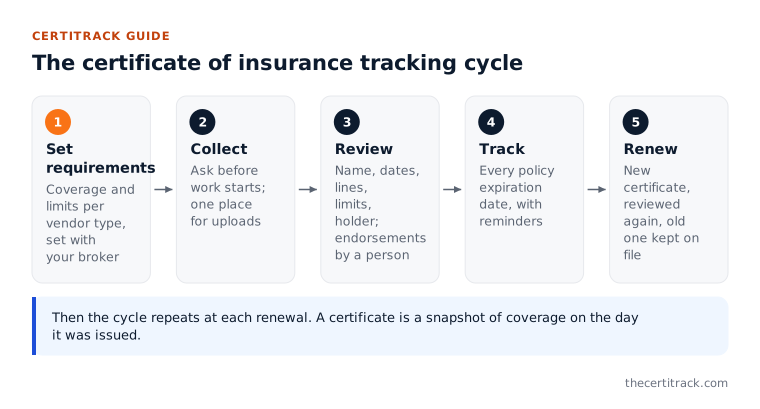
A certificate of insurance (often called a COI) is a one-page summary of a vendor’s insurance policies. In the US it is almost always the ACORD 25 form. It shows who is insured, which insurers wrote the policies, the policy numbers, the dates the coverage runs, and the limits. It is a snapshot. The day after it is issued, a policy can be cancelled or changed and the certificate will not tell you.
That is why tracking is a process, not a filing task. If you want a line-by-line look at the form itself, see how to read an ACORD 25.
Why certificate of insurance tracking matters
When a vendor’s employee is hurt on your site, or a vendor damages a tenant’s property, the first question is whose insurance responds. If the vendor’s coverage had lapsed, the claim can land on your own policy, or on you directly. A certificate on file that expired four months ago does not help.
There are quieter reasons too:
- Your own insurer may ask. At audit time, some carriers ask for proof that your subcontractors carried their own coverage. Without it, the audit can treat those subs as your exposure.
- Your contracts often require it. Property owners, general contractors, and larger customers commonly require you to make sure your own vendors carry insurance. If you cannot show it, you may be out of compliance with your own contract.
- It forces a conversation before work starts. Asking for a certificate early surfaces vendors who are underinsured while you still have time to choose someone else.
Tracking certificates is one part of a wider vendor compliance management process, which also covers licenses, W-9s, and other documents.
What to collect from each vendor
Start with a short list. For most vendors, you are looking for proof of some combination of these:
| Coverage | What it covers, in plain terms | Common for |
|---|---|---|
| Commercial general liability | Injury to other people or damage to their property caused by the vendor’s work | Almost every vendor that comes on site |
| Workers compensation and employers’ liability | The vendor’s own employees if they are hurt on the job | Any vendor with employees doing physical work |
| Commercial auto liability | Accidents involving vehicles the vendor uses for the work | Delivery, trades with trucks, logistics |
| Umbrella or excess liability | Extra limits on top of the underlying policies | Higher-risk work, larger contracts |
| Professional liability (errors and omissions) | Mistakes in professional advice or services | Consultants, engineers, IT providers |
Not every vendor needs every line. A solo bookkeeper working remotely is a different risk from a roofing sub with a crew of eight. For a fuller list that includes licenses, W-9s, and contracts, see the vendor compliance checklist.
How to set your insurance requirements
Before you can check a certificate, you need to know what “good” looks like. Your requirements usually come from three places:
- Your contracts. If a client or property owner requires you to carry certain coverage, they often require you to pass similar requirements down to your vendors.
- Your own insurer and broker. Your broker can tell you what your policy expects of the vendors you hire.
- The work itself. Someone running electrical work on a live building is a different risk from someone delivering office supplies.
Requirements are usually written as per-occurrence and aggregate amounts for each type of coverage. The right numbers depend on the contract, the work, and your broker’s advice, so there is no single standard to copy. Write them down once, by vendor type, and put them in your vendor contracts so there is no argument later.
A simple way to start is two or three tiers:
- Low risk: off-site services, office suppliers, remote consultants.
- Medium risk: cleaners, landscapers, general maintenance.
- High risk: trades, roofing, electrical, anything at height or with heavy equipment.
Each tier gets its own list of required coverage and limits, set with your broker.
How to collect certificates
The vendor does not usually produce the certificate themselves. Their insurance agent or broker issues it. So your request needs to give the vendor everything their agent needs:
- The coverage types and limits you require.
- Your exact legal name and mailing address, as you want them in the certificate holder section.
- Whether you need to be named as an additional insured, and the exact wording your contract uses.
- Any project name or location you want mentioned in the description section.
- A deadline, ideally before the vendor starts work.
Collecting by email works when you have a handful of vendors. It gets messy once files arrive from different addresses, in different formats, and sometimes in the body of a reply-all thread. A single place where vendors upload documents, ideally from their phone and without having to create an account, keeps everything together.
How to review a certificate of insurance
When a certificate comes in, compare it against your requirements before you file it. Here is a checklist that catches most problems:
- Insured name. Does it match the legal name on your contract and the vendor’s W-9? “Ridgeline Electric” and “Ridgeline Electrical Services LLC” may not be the same entity.
- Dates. Is every policy currently in force? Check the effective and expiration dates on each line, not just the date at the top (that is the date the certificate was issued).
- Coverage types. Is every required line present? A missing workers compensation line is easy to overlook when the general liability limits look good.
- Limits. Do the limits meet or exceed what your contract requires, line by line? (Each occurrence vs. aggregate limits explains the numbers.)
- Certificate holder. Is your name and address correct?
- Insurers. Are the insurers named, with their NAIC numbers? You can look up an insurer’s details through the NAIC or your state insurance department if something looks off.
- Description section. Does it mention your project or location if your contract requires that?
Endorsements need a human check
Many contracts require endorsements: additional insured status, a waiver of subrogation, or primary and non-contributory wording. The certificate has small columns marked “ADDL INSD” and “SUBR WVD”, but a checkmark there is not the endorsement. The certificate itself says it does not change or extend the coverage, and that additional insured status requires an endorsement on the policy.
To confirm these, ask the vendor or their agent for a copy of the endorsement itself and read it, or have your broker review it. Software will not do this reliably, and CertiTrack does not check endorsements for you. It reads dates, policy numbers, insurers, and limits; endorsement wording stays with a person.
How to track expiration dates
Every policy on a certificate has its own expiration date. A vendor’s general liability might renew in March while their auto policy renews in August. Tracking means watching each date, not just one per vendor.
What works:
- Record every policy’s expiration date separately, not just the earliest one.
- Start asking early. Many renewals take weeks, and the vendor needs to get a new certificate from their agent. A reminder 90 days out is not too early for important vendors.
- Remind on a schedule, not from memory. A sequence such as 90, 60, 30, and 7 days before expiry gives the vendor several chances without anyone on your team needing to remember.
- Have one owner. Someone on your team is responsible for following up when a reminder is ignored.
CertiTrack reads the effective and expiration dates from each uploaded document (you confirm what it read) and emails the vendor automatically at 90, 60, 30, and 7 days before a document expires, with a secure link to upload the renewal and a copy to your team. The dashboard shows what is expiring soon across all vendors.
How to handle renewals
A renewal is not done when the vendor says “we renewed”. It is done when you have the new certificate, you have checked it the same way you checked the first one, and it has replaced the old one as your version of record.
Watch for these on renewal:
- Limits that dropped. Vendors sometimes renew with lower limits to save premium.
- A new insurer. A new carrier means a new policy number and possibly different terms. Endorsements may need to be re-issued too.
- A changed insured name. A vendor who restructured may now operate under a different entity.
Keep the old certificate on file. If a claim comes in later about work done last year, you will want to show what coverage was in place at that time.
What to do when a certificate has gaps
Sooner or later a certificate will come back short: a missing line, a low limit, an expired policy, the wrong name. A calm, consistent process helps:
- Tell the vendor exactly what is wrong. “Your workers compensation line is missing” gets fixed faster than “your COI is not compliant”.
- Copy their insurance agent if you can. The agent is the one who issues the corrected certificate.
- Decide whether work can start or continue. Your contract and your management should decide this, not whoever happens to notice the problem.
- Hold payment if your contract allows it. Some contracts make current insurance a condition of payment. A quick compliance check before each payment catches gaps at the moment they matter.
- Write it down. Note the date you asked, what you asked for, and the response.
Spreadsheet or software?
Plenty of teams track certificates in a spreadsheet, and with a small number of vendors it can work. A typical sheet has one row per policy, with columns for the vendor, coverage type, policy number, insurer, limits, and expiration date, plus conditional formatting to turn rows red as dates approach.
The spreadsheet starts to break when:
- Nobody is reminded. A cell turning red only helps if someone opens the file.
- Files live somewhere else. The sheet says a certificate is current, but the PDF is in someone’s inbox.
- More than one person edits it. Copies multiply, and nobody is sure which is the latest.
- Vendors grow. Typing dates and limits from every certificate by hand takes time, and typos happen.
Software built for this does the reminders, keeps the document and the data together, and gives everyone the same view. The trade-off is cost and a bit of setup. If you have a handful of vendors and one careful person, a spreadsheet is fine. If you have dozens of vendors, several people involved, or you have been caught by a lapsed certificate before, it is worth looking at a dedicated tool. CertiTrack also warns you when you mark a payment as paid to a vendor who is not compliant. Its Free plan covers up to 5 vendors, so you can try it on your highest-risk vendors first; see pricing for the larger plans.
Common questions
How often should I ask vendors for a new certificate?
At least every time a policy renews, which is usually once a year per policy. Also ask whenever a vendor changes insurers, changes its legal name, or starts a new type of work for you.
Who is responsible for providing the certificate, the vendor or their agent?
The vendor is responsible for getting it to you, but their insurance agent or broker actually issues it. Including the agent in your request often speeds things up.
Is a certificate of insurance proof that coverage is in force?
It is evidence that coverage was in place on the date it was issued. It does not guarantee the policy has not been cancelled since. That is why checking dates regularly and asking for updated certificates matters.
Should I keep expired certificates?
Yes. Keep them as a record of what coverage was in place at the time the work was done. Claims can surface long after a job ends.
Can I accept a certificate that the vendor filled in themselves?
Be cautious. Certificates are normally issued by the vendor’s agent or broker, whose name and contact details appear in the producer section. If a certificate looks edited or the producer details are missing, contact the agent directly to confirm.